



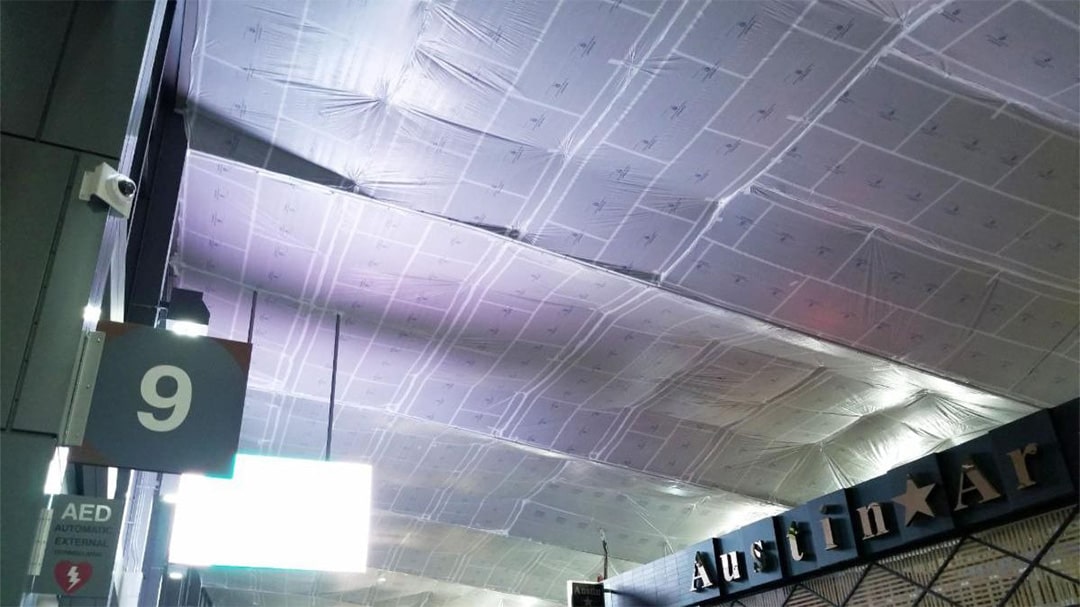
Emergency Roof Repair at an International Airport Terminal
The Situation
A sudden, severe storm damaged the roof structure of a terminal section at an international airport, requiring a full roof replacement. With no advance warning, the airport had no pre-scheduled contractor or plan in place—every day of delay meant disrupted flights, rerouted passengers, and higher operational costs. Closing the terminal for the duration of repairs was not viable.
The Challenge
The airport needed a containment solution that would let crews demolish and rebuild the roof overhead while the terminal stayed open and operating normally below—with no disruption to passenger flow and full compliance with fire code and sprinkler system requirements. Given the scale of an airport terminal, the job also required enough manpower to move quickly across a large area, not just a small crew working incrementally.
The Response
Because TuffWrap maintains a large in-house installation workforce, we could mobilize a crew large enough to take on a job of this scale and have them on-site within days of the storm. That staffing capacity meant the project didn’t have to wait on subcontractors or additional hiring — the crew needed to assess the space, engineer the containment plan, and begin installation was already available and ready to deploy.
We used our SmartSeam® Suspended Cover to create a sealed barrier below the work zone, separating the active repair area above from the occupied terminal below. The system complies with the International Fire Code and UL-723S, allowing installation under the terminal’s existing fire sprinklers without disabling them.
With the cover in place, roofing crews worked overhead while the terminal continued normal operations underneath—passengers, staff, and flights were unaffected by the work above.
Takedown
Once repairs were complete, TuffWrap used our High Structural Dust Removal ability to clear all dust and debris that had accumulated above the barrier during the project, returning the terminal to a clean, passenger-ready condition before the cover came down.
The Result
The terminal remained open throughout the repair. Flights stayed on schedule, and the airport avoided what could have been a multi-week closure. The project was completed quickly, safely, and in full compliance with fire code requirements—from initial storm damage to a fully repaired roof in a matter of days —backed by a crew with the capacity to handle an emergency at airport scale.