


Code Compliance for Temporary Containment Systems: What Contractors Need to Know
Temporary containment is common in reroofing, renovation, and interior construction. But in an occupied or operating facility, controlling dust and debris is only part of the job. Containment must also be considered in the context of fire safety, sprinkler performance, building codes, and facility requirements.
Contractors should plan containment with compliance in mind before installation, not after a problem occurs.
Why Code Compliance Matters for Temporary Containment
A temporary wall or suspended cover can affect more than the construction area. It may interact with:
- Automatic sprinkler systems
- Egress paths
- Fire and smoke protection
- Building systems and equipment
- Occupied spaces
- Facility operations
- Inspection requirements
This matters most in active facilities where construction happens alongside employees, customers, patients, production, or inventory. A containment system that controls dust well may not automatically address fire performance or sprinkler considerations. That’s why temporary containment should be treated as an engineered part of the project, not simply a field-installed barrier.
Common Containment Mistakes to Avoid
Most containment problems aren’t intentional. They happen when a temporary solution is installed quickly without considering how it interacts with the facility.
- Hanging poly sheeting directly beneath sprinklers: Plastic may seem like a simple way to contain dust, but material installed beneath sprinklers affects water distribution during a fire. Consider sprinkler discharge patterns and obstruction requirements when designing containment beneath an automatic sprinkler system.
- Using materials without considering fire performance: Plastic films, tarps, and temporary barriers don’t all have the same fire characteristics. Contractors need to understand the fire performance of their materials and whether product documentation supports the intended application.
- Blocking sprinkler discharge: Containment should not interfere with sprinkler operation, particularly temporary ceiling or suspended systems installed beneath automatic sprinklers.
- Creating unstable or incomplete barriers: Containment must remain effective throughout the project. Loose materials, gaps, unplanned openings, and unstable attachment points allow dust and debris to migrate or create other operational concerns.
- Treating every facility the same: A barrier in an empty construction space may have very different requirements from one in a manufacturing plant, hospital, food-processing facility, or retail location. The type of facility should drive the containment strategy.
Key Codes and Standards to Understand
There is no single universal temporary containment code. Requirements depend on the application, building, jurisdiction, and AHJ (Authority Having Jurisdiction). However, several standards and code considerations frequently come into the conversation.
NFPA 13 and Sprinkler Considerations
NFPA 13, Standard for the Installation of Sprinkler Systems, is an important reference when temporary containment is installed near automatic sprinklers. Certain provisions address obstructions and open-grid materials around sprinkler systems. The important takeaway for contractors isn’t to memorize every dimension or percentage.It’s this:
A temporary barrier installed beneath sprinklers needs to be evaluated for its potential effect on sprinkler performance.
TuffWrap’s TuffNet is designed with open-grid criteria referenced in NFPA 13 in mind. Its ¼-inch knitted mesh is intended for suspended-cover applications where debris protection is needed while maintaining a sprinkler-conscious design.
For a specific project, applicable NFPA provisions and the proposed installation should be reviewed with the project’s fire protection professionals and AHJ.
ASTM E84 and Fire Performance
ASTM E84 is a widely used test method for evaluating the comparative surface-burning characteristics of building materials.
The test measures characteristics including flame spread and smoke developed under controlled laboratory conditions. ASTM specifically notes that E84 is a comparative fire-test-response method and does not, by itself, address every factor involved in assessing fire hazard or risk. That’s an important distinction.
An ASTM E84 result can provide nformation about a material’s surface-burning characteristics, but contractors should not assume that an E84 rating alone satisfies every building or fire-code requirement. ASTM E84 Class A is just one piece of a larger compliance picture.
A New ASTM Standard for Temporary Ceiling Containment
Contractors working on reroofing and overhead construction also have a new standard to consider.
ASTM D8662/D8662M-26, Standard Specification for Plastic Temporary Ceiling Construction Barriers for Installation Below Automatic Sprinklers, establishes a dedicated specification for this type of temporary ceiling barrier.
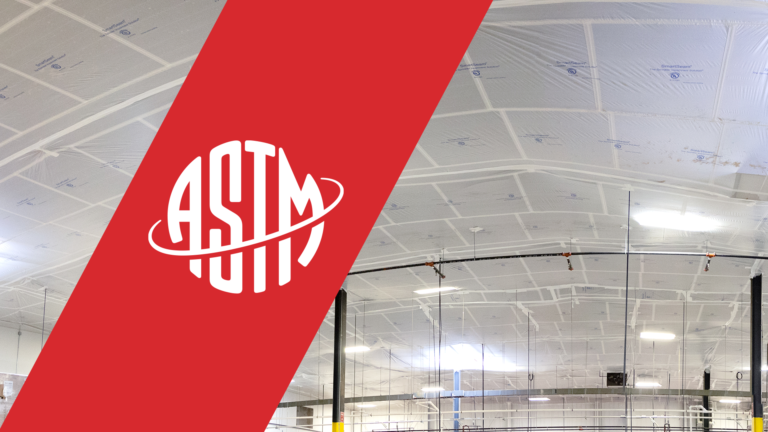
The standard addresses temporary plastic barriers used beneath roof or ceiling construction to help protect people and equipment from dust and light debris while allowing operations to continue. It also addresses factors including sprinkler performance, static pressure, durability, fire performance, stability, and installation.
For contractors, this is an important development. Temporary ceiling containment now has a ASTM specification against which systems can be evaluated. TuffWrap’s SmartSeam Suspended Cover is certified to ASTM D8662/D8662M-26 requirements.
Occupied Facilities Require More Planning
Containment gets more complicated when the facility can’t stop operating. Consider:
- A manufacturing plant where production continues below a reroofing project
- A food or beverage facility where contamination control is critical
- A hospital where construction occurs near occupied areas
- A retail location that needs to remain open
- A warehouse where inventory and equipment must stay protected
- A school where construction takes place alongside occupants
In these environments, containment has to accomplish multiple goals at once. It needs to help control construction dust and debris without creating new problems for the facility. That can mean coordinating containment with sprinkler locations, HVAC systems, access routes, egress paths, equipment, production areas, and facility-specific requirements.
What Should Contractors Look for in a Temporary Containment System?
Before selecting a containment solution, ask yourself a few basic questions.
- Is it Engineered for the Application? Look for systems designed specifically for construction containment rather than generic materials being adapted in the field.
- What is the Fire Performance? Review available testing and documentation for the actual material or system being specified.
- How Does it Interact With Sprinklers? If containment will be installed beneath or near automatic sprinklers, consider how the system could affect sprinkler discharge.
- Can it Be Properly Sealed? A barrier with gaps, uncontrolled openings, or poorly planned transitions can undermine the entire containment strategy.
- Can the Facility Keep Operating? The best containment solution isn’t necessarily the biggest one. It is the one that provides the protection required while allowing the facility to function.
- Is Documentation Available? Ask for specifications, test reports, certifications, installation information, and other technical documentation that supports the proposed application.
Engineered Systems vs. Improvised Barriers
There’s a difference between putting up barriers to stop migrating dust and designing a containment system. Improvised solutions may include loose poly sheeting, tarps, or materials zip-tied wherever they appear to fit. These approaches may not always address the requirements of an active facility. Engineered containment systems are designed with the overall application in mind.
TuffWrap’s solutions include:
SmartSeam Suspended Cover – An engineered temporary ceiling system for overhead construction and reroofing. SmartSeam is designed to contain dust and debris while addressing sprinkler and fire-performance considerations.
TuffNet – A suspended debris netting solution designed around open-grid criteria referenced in NFPA 13 for sprinkler-conscious applications. TuffNet can be integrated with SmartSeam when additional debris protection is needed.
Frameless Walls and Hybrid Walls – Interior containment systems designed to separate construction areas from active facility operations while adapting to complex facility layouts.
Total Enclosures – For projects requiring containment from multiple directions, TuffWrap can combine wall and suspended-cover systems to create a fully enclosed construction environment.
The result is a containment strategy designed around the project, not a temporary barrier improvised after construction begins.
Work With the AHJ Early
Code compliance isn’t something a manufacturer or contractor should determine in isolation. Project requirements can vary based on jurisdiction, building conditions, occupancy, construction activity, and the AHJ. Before installation, contractors should coordinate with the appropriate project stakeholders and, when necessary, fire protection professionals and the AHJ. Early coordination can prevent costly changes once containment is installed. That may include reviewing:
- The proposed containment layout
- Sprinkler locations
- Material specifications
- Fire-performance documentation
- Access and egress
- Facility-specific requirements
- Installation methods
Build Compliance Into the Containment Plan
Temporary containment may only be installed for a few weeks or months, but that doesn’t mean it can be treated as an afterthought. In an occupied facility, the right system needs to balance dust control, fire safety, sprinkler performance, access, and operational continuity.
TuffWrap specializes in engineered temporary containment systems designed for active construction environments. From SmartSeam and TuffNet to Frameless Walls, Hybrid Walls, and Total Enclosures, TuffWrap enables contractors to build containment strategies around the demands of the facility.
Plan containment early. Choose engineered solutions. Keep the project moving.
Need help selecting a containment solution for your project? Talk with TuffWrap about compliance-conscious containment solutions for occupied facilities.