


Code Compliance for Temporary Containment Systems: Why It Matters in Occupied Facilities
Contractors often treat temporary dust containment as a straightforward requirement: hang a barrier, control the dust, and keep working. In an occupied facility, it is rarely that simple.
Temporary walls, suspended covers, and other containment systems can interact with fire protection systems, building conditions, ventilation, facility operations, and occupant safety. A system that works as a basic dust barrier might not be appropriate beneath an active sprinkler system or in a facility where construction must continue without disrupting operations.
For contractors, facility managers, architects, and fire protection professionals, the key question is not whether a containment system controls dust. It is whether the team designed, tested, and installed the system for the conditions of the project.
What Does “Code Compliance” Mean?
No single designation makes every temporary containment installation code compliant. Requirements vary with the building, occupancy, sprinkler configuration, materials, installation method, jurisdiction, and project conditions. They may involve the International Building Code (IBC), International Fire Code (IFC), NFPA standards, ASTM standards, UL classifications, FM Approvals, and requirements the local Authority Having Jurisdiction (AHJ) establishes.
These distinctions in code compliance matter. A material can have a particular fire-performance rating, but that does not mean every installation using it meets every applicable requirement. How teams design and install a containment system can be just as important as the material itself.
For temporary ceiling containment beneath automatic sprinklers, ASTM now provides a dedicated specification. ASTM D8662/D8662M-26, Standard Specification for Plastic Temporary Ceiling Construction Barriers for Installation Below Automatic Sprinklers, addresses temporary plastic barriers used during construction and renovation to protect workers, occupants, equipment, and operations from dust and light debris. It covers sprinkler performance, static pressure, durability, fire performance, stability, and installation.
In other words, the industry increasingly evaluates temporary containment as an engineered building component, not simply temporary sheeting.
Why Temporary Containment Affects Fire Protection
Automatic sprinkler systems respond to fire conditions and distribute water over a defined area. Temporary barriers installed near or below sprinklers can affect that performance.
A poorly planned barrier can interfere with:
- Sprinkler heat collection and activation
- Water distribution and spray patterns
- Air movement around sprinkler heads
- Access to sprinkler components
- Required clearance and operating conditions
Loose poly sheeting, tarps, and other improvised barriers may be easy to install, but manufacturers don’t typically design them for the environments in which contractors use them. A temporary ceiling beneath an active sprinkler system presents very different considerations than a simple vertical dust wall.
The goal is not to eliminate temporary containment but to select an approach that accounts for how the system will interact with the facility’s existing fire protection and building systems.
Understanding NFPA 13 and Open-Grid Considerations
NFPA 13, Standard for the Installation of Sprinkler Systems, is an important reference when evaluating temporary conditions around automatic sprinklers.
Certain provisions address obstructions and open-grid materials in relation to sprinkler discharge. Specific requirements depend on the applicable edition of the standard and the conditions of the installation. Contractors may encounter criteria involving opening dimensions, open-area percentages, material depth, and the relationship between the temporary barrier and sprinkler discharge.
The reason is straightforward: water needs to get where it should go.
A temporary barrier that is too dense, too deep, improperly positioned, or otherwise interferes with sprinkler operation can create a fire-protection concern. Contractors should not assume a product is suitable simply because it is lightweight, temporary, or commonly used on construction sites.
Project teams should review applicable requirements with the fire protection professional and AHJ when necessary, particularly when they install containment near or beneath active sprinklers.
Why Improvised Containment Creates Unnecessary Risk
Crews frequently assemble temporary containment in the field from whatever is readily available. Poly sheeting, tarps, tape, and temporary framing can be effective for some applications, but they don’t address the full range of conditions in an occupied facility.
Common challenges include:
- Selecting materials without considering fire performance
- Hanging barriers directly beneath sprinkler systems
- Creating unintended sprinkler obstructions
- Leaving gaps that allow dust migration
- Installing barriers without adequate attachment or support
- Modifying containment after installation to accommodate equipment or workers
- Failing to consider HVAC, access, or facility operations
These issues do not necessarily mean an improvised system will fail. They show why teams should evaluate containment as part of the overall project rather than treat it as an afterthought. The more complex the facility, the more important that planning becomes.
What Makes an Engineered Containment System Different?
An engineered containment system begins with the conditions of the project. Instead of deciding where to hang plastic after construction begins, the project team can evaluate the work area, facility operations, sprinkler configuration, attachment points, access requirements, and environmental conditions before installation.
TuffWrap approaches temporary containment this way.
SmartSeam Suspended Cover
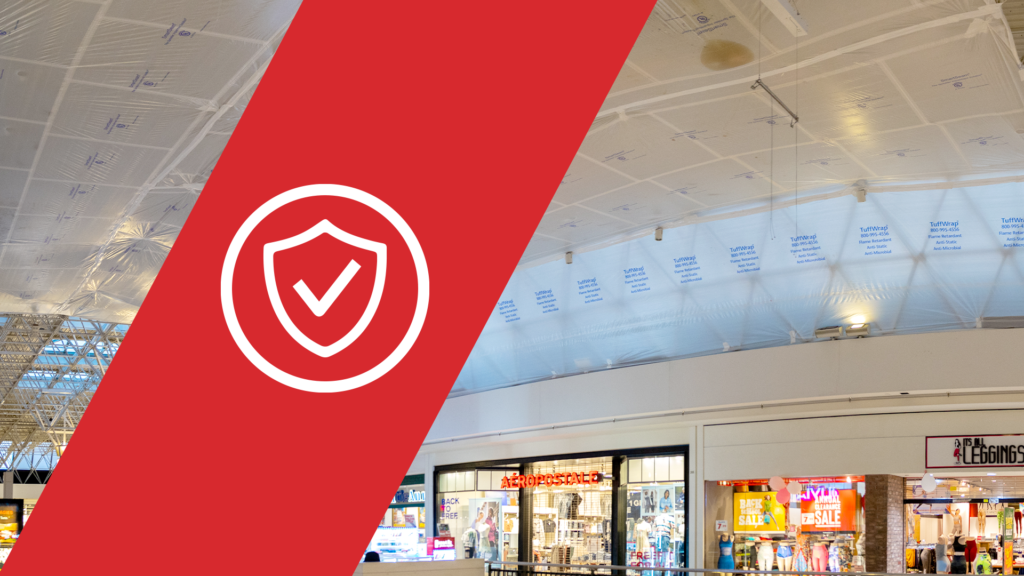
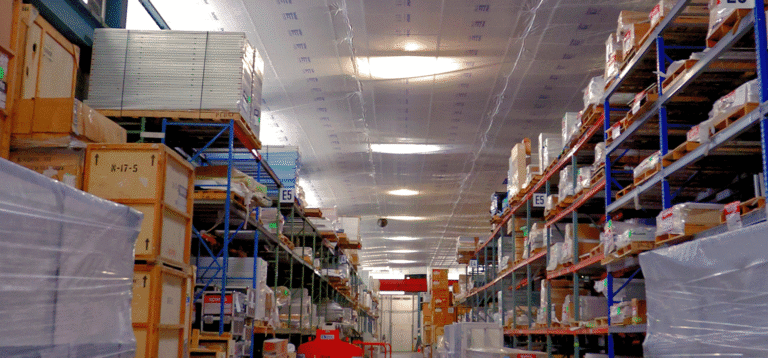
For overhead construction and reroofing, TuffWrap’s SmartSeam Suspended Cover creates a temporary ceiling between construction activity and the occupied space below.
TuffWrap designed SmartSeam specifically for suspended-cover applications in active facilities. TuffWrap engineered its heat-reactive seam to open during a fire event, helping minimize interference with sprinkler operation. See the fire safety test here.
Multiple third-party programs, including FM 4652 and IBC evaluation requirements, have evaluated SmartSeam, and it is classified for applicable fire-performance characteristics. It is now certified to ASTM D8662/D8662M-26, which specifically addresses plastic temporary ceiling construction barriers installed below automatic sprinklers.
That combination of engineered design, testing, and documented performance gives project teams information they can use when evaluating temporary ceiling containment.
TuffNet Suspended Protection
When overhead work involves more than dust and light debris, TuffNet provides a debris-netting option for suspended containment.
TuffNet features 1/4-inch openings, and TuffWrap designed it around the open-grid criteria referenced in NFPA 13 for sprinkler-conscious applications. You can also integrate it with SmartSeam as part of a broader suspended containment system.
The right solution depends on the type of work, the material being contained, the facility environment, and the applicable project requirements.
Occupied Facilities Require More Planning
Code-conscious containment becomes especially important when construction takes place while a facility remains operational. Consider environments such as:
- Hospitals and healthcare facilities
- Pharmaceutical manufacturing
- Food and beverage production
- Manufacturing plants
- Retail facilities
- Warehouses and distribution centers
- Schools and public buildings
- Data centers
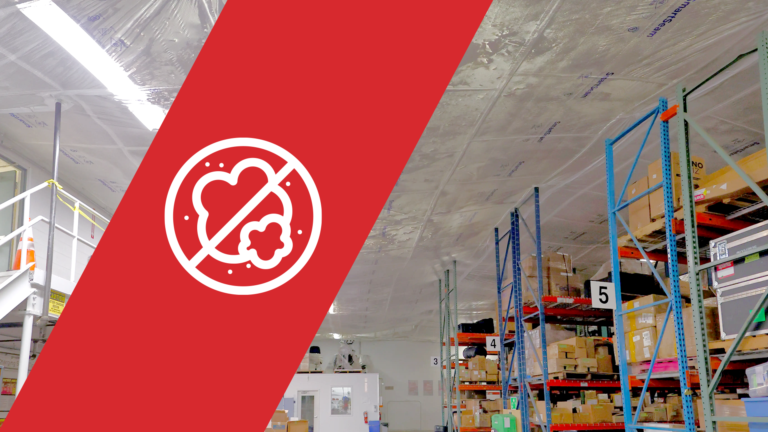
In these environments, containment failure can affect much more than the construction area. Dust can contaminate products, debris can damage equipment, construction activity can interfere with production, and an improperly designed barrier can create fire-protection concerns. The objective is not simply to build a barrier around the work. It is to create a controlled construction environment while allowing the facility to continue operating safely.
Compliance Is More Than Material Selection
Crews must use even a well-tested containment material correctly. Compliance-conscious planning should consider:
- Design: How will the system interact with the existing building and fire protection systems?
- Installation: How will the team support, seal, and attach the barrier?
- Sprinklers: Could the temporary installation affect sprinkler activation or discharge?
- HVAC: Will the containment change airflow or pressure conditions?
- Access: How will workers, equipment, and emergency personnel move through the area?
- Sequencing: Will the containment configuration change as construction progresses?
- Documentation: Are testing, certification, evaluation, and product specifications available for review?
- AHJ coordination: Does the local Authority Having Jurisdiction have project-specific requirements?
Address these questions before installation, not after an inspector, facility manager, or fire protection professional identifies a problem.
Engineered Containment for Active Facilities
TuffWrap specializes in temporary containment for facilities that cannot simply shut down during construction. It designs its systems around the realities of active environments, including overhead construction, reroofing, renovation, manufacturing, food production, retail, warehousing, and other occupied spaces.
The TuffWrap approach combines engineered system design, purpose-built materials, third-party testing and evaluation, and professional installation. TuffWrap designs its suspended cover solutions to control dust and debris while addressing the fire-safety and operational considerations of temporary containment in active facilities.
That distinction matters when a project cannot afford to treat containment as an improvised field solution.
Plan Containment With Compliance in Mind
Temporary containment protects more than the construction area. In an occupied facility, it becomes part of the environment surrounding workers, occupants, equipment, products, and life-safety systems. Teams should therefore consider fire protection, sprinkler interaction, material performance, installation methods, and project-specific requirements before installing containment.
No universal containment solution fits every project, and compliance ultimately depends on the applicable codes, conditions, and AHJ requirements. But choosing an engineered system with documented performance gives contractors and facility teams a stronger foundation for compliance-conscious planning.
TuffWrap brings that individualized approach to every project. From suspended covers and interior walls to debris netting and complete containment systems, TuffWrap has a code-conscious solution for your next project.
Planning construction in an occupied facility? Talk with TuffWrap about an engineered containment solution designed with fire safety, operational continuity, and project requirements in mind.
Ph: (800) 995-4556 | tuffwrap.com